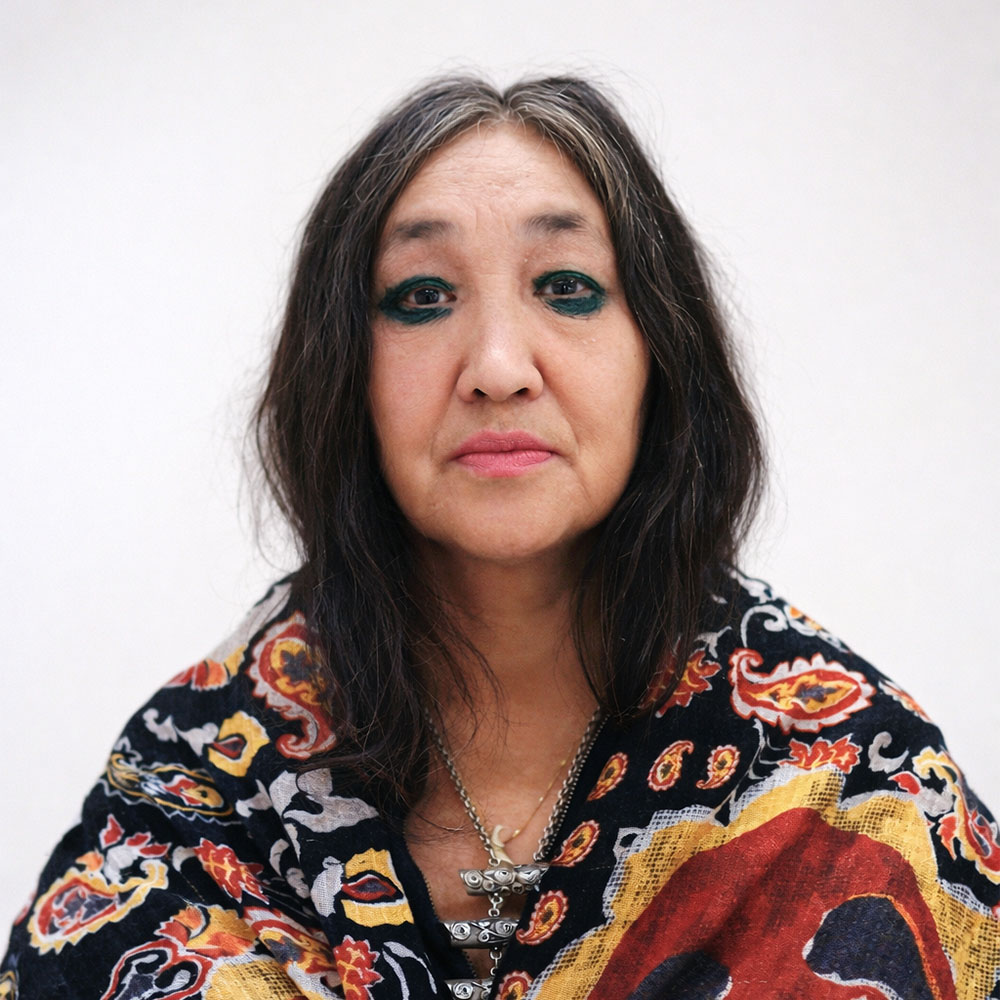
A celebrated improviser and vocal artist, Saadet Türköz was born in Istanbul in 1961 in the family of Kazakhs from East Turkestan, who left their homeland because of oppressive Chinese policies, and lived in India and Pakistan before relocating to Türkiye. Living in Switzerland since 1981, her music is heavily influenced by all these geographical entanglements, and of course, traditional songs from Kazakhstan and East Turkestan. Over a few decades of her career, her style incorporated many new influences, including improvisation, free jazz, experimental vocal practice, sound poetry, and modern popular music from all the countries she relates to.
Through the years, Saadet has developed her own unique style of singing, which cannot easily be characterized. It is very physical, visceral, and expressive, constantly shifting between extremes: what sounds like ancient chants mutates into extended vocal improvisation, which quickly gives way to a Kazakh kui, then transforms into a calm incantation resembling a lullaby that her mother once sang to her, only to explode into a lively recitation, almost as if Saadet is participating in aitys, involved in an oratorical battle of wits with herself as an opponent. Inspired by many things at once, from the poems of Abai Qunanbajuly to archaic Swiss yodeling, her voice exists between states, never fully leaning into one of them—between the past and the future, the traditional and the contemporary. Saadet is not interested in glorifying or sanctifying these musical roots; her gaze is not directed toward the past — it draws from the past and, in the fusion of all her influences, points toward a future in which people live in harmony with who they are, closer to their origins and the surrounding nature.
Working both as a solo artist and as a collaborator in duos, trios, and larger free-improvising formations, Saadet has, throughout her career, collaborated with many renowned musicians, including Elliott Sharp, Bobby McFerrin, Miya Masaoka, and others. Over the last few years, she has also formed a strong connection with the young generation of the Kazakhstani independent and experimental music scene, which has resulted in her playing one of the main roles in BARSAKELMES, an inaugural performance that launched the public program of the Tselinny Center of Contemporary Culture.