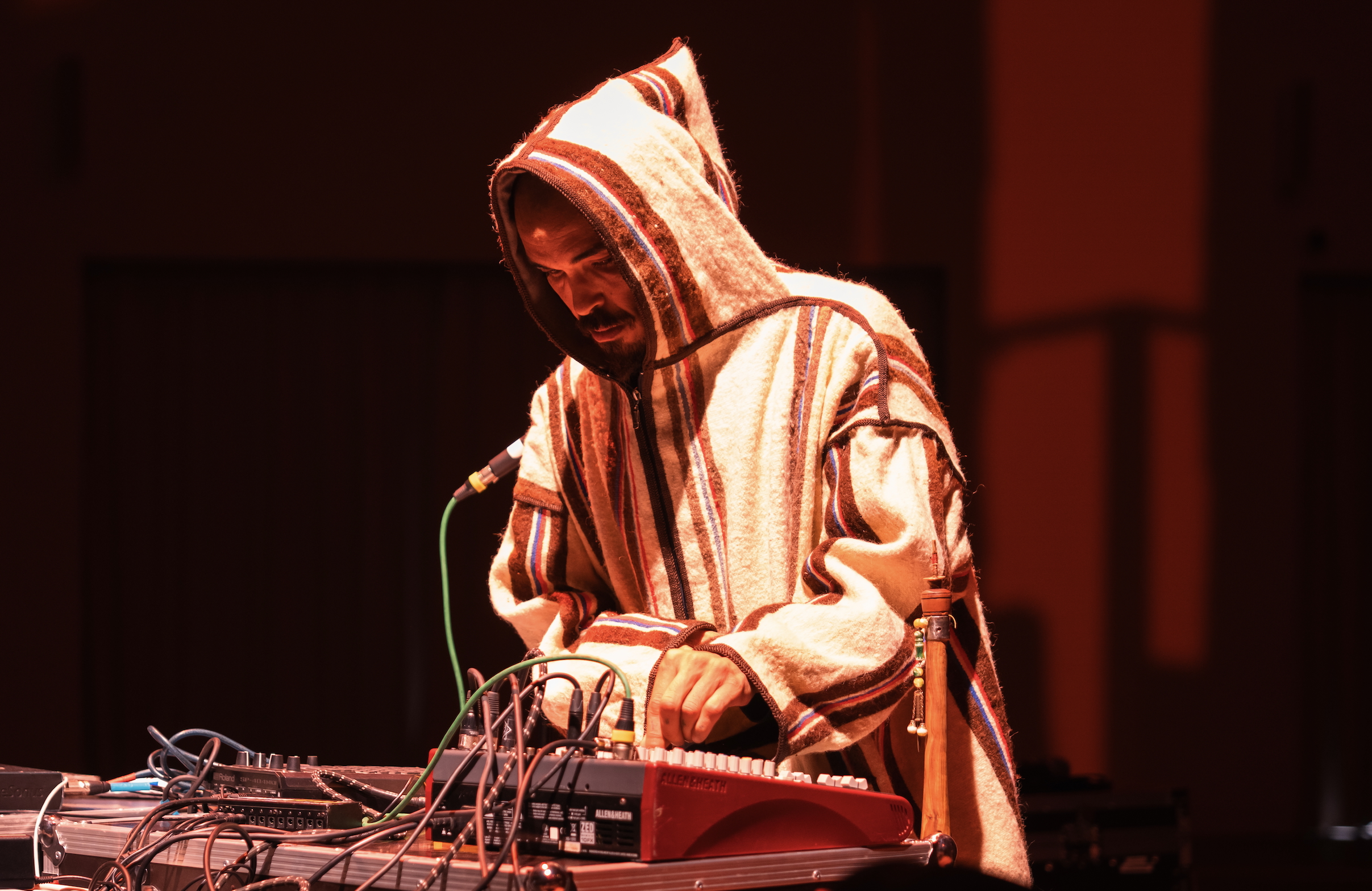
Rami Harrabi (b. 1989) is a Tunisian artist, performer, composer, and sound designer, who is enthralled by Arab and North African instruments, traditions, and rituals. His research focuses on a range of traditional instruments popular in North Africa and West Asia, including the mezwed, mezwej, matbeg, yarghoul, and others. These instruments are typically played using a range of microintervals that allow for the creation of complex melodies, and many feature double reeds, meaning two reeds vibrate simultaneously to produce sound — enabling very complex microtonal melodies and harmonies, as well as multiphonic effects.
Working under the artistic name Virus2020 (فيروس ٢٠٢٠), Rami creates soundscapes that transcend divisions — works in which it is impossible to identify a single cultural origin, where boundaries dissolve. His approach combines elements of tradition and modernity, blending acoustic and electronic textures seamlessly, and incorporating a range of analogue and digital machines alongside handcrafted wind instruments.
In October 2025, Rami participated in the Resynthesising the Traditional artistic research lab, a joint project between Korkut Sonic Arts Triennale and Berlin’s CTM Festival, which took place at the Tseliny Center for Contemporary Culture in Almaty.
Intersection (2024)
Film
Intersection by Rami Harrabi is a short film centered on hybrid, handmade wind instruments rooted in North African traditions, along with the rituals and belief systems that surround them, reinterpreting these cultural references through a contemporary perspective — the intersection between acoustic and electronic sound. Over the course of the film, Rami focuses on the process of creation, showing himself working on unique musical instruments made from organic materials such as cow horn, goat skin, bamboo, and beeswax, emphasizing a tactile connection to nature and regional histories.
In Intersection, these instruments become sites where ideas of life and death converge. Their organic materials undergo gradual transformation — decay and rot — while breath acts as the natural force that activates and “awakens” them into sound.