Rites
of Eternal Wind
Il Korkut Sonic Arts Triennale
Dedicated to sound and listening, the Triennale creates a space for a wide range of sonic practices without restricting them by institutional boundaries. Over the course of two months, Rites of Eternal Wind will host sound installations and live events, listening sessions and soundwalks, hybrid lectures, discussions and workshops, somatic performances and explorations of sonic rituals and environments where sound is absent or even impossible.
Tselinny Center of Contemporary Culture
Nurbäk Batulla

Biography

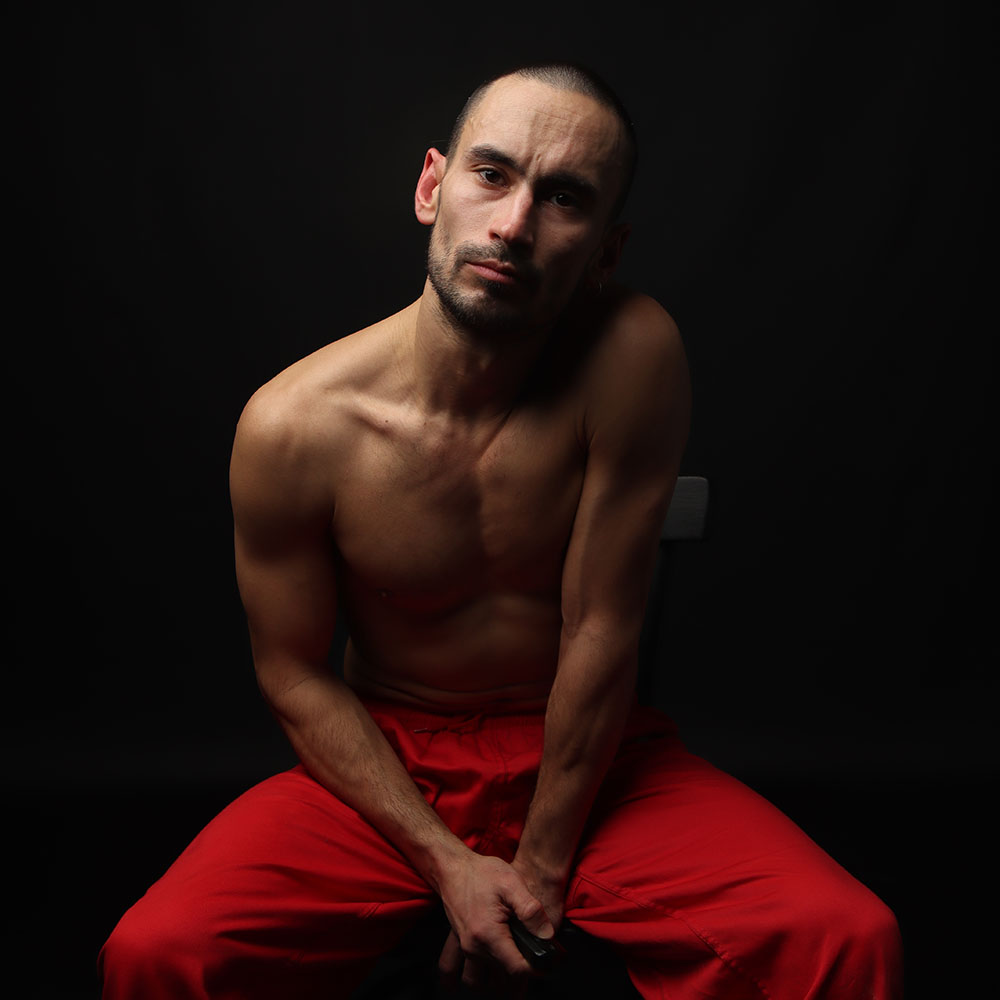
Nurbäk Batulla (b. 1988) is a choreographer, dance and performance artist from Tatarstan. His practice, close to physical theater, uses movement as a tool to explore body and mind, focusing on the result rather than the process. He is mostly interested in body language. This search is directly connected to how Nurbäk assesses his mother tongue — Tatar, a severely endangered language whose scope of use is being artificially narrowed, whose role in school education is being diminished, and whose number of speakers is decreasing every year.  He traces current linguistic policies in himself as well — before the age of seven, Nurbäk spoke and thought in Tatar, but later Russian became his primary language of speech and thought. His subsequent attempts to return to thinking in Tatar led him to seek out an even more ancient means of communication—body language, through which people express far more than they can with words.

In his performances, Nurbäk trains his body, voice, and mind to become a medium between the world of ideas and the audience. He takes physical fatigue to the extreme, turning it into a key to understanding corporeality and a state in which the spiritual world penetrates the body at the moment when the body no longer has the strength to resist.
Rite of Qūralai
Performance (2026)

Rites of Eternal Wind will feature multiple appearances by Nurbäk.

Besides his performance of a piece by Mieko Shiomi during the opening concert and his participation in the Triennale’s Discourse Program, he was also commissioned to develop a collective work in collaboration with sound artist and composer Lovozero, and director and founding member of Almaty’s Jolda dance collective, Zhanna Tulendy. Titled Rite of Qūralai, this performative work centers on corporeal/sonic phenomenologies and the human capacity for reconfiguration; it draws on experiences of interaction with low temperatures and on the evidence of myth that emerges from this experience.

In Rite of Qūralai, artists and performers engage with somatic intuition, sonic events taking place within the speculative space of winter, aggregate states of breath—breathing—sounding, and symbiotic connections between images, memory, low temperatures, and acoustic phenomena. Through collective action, wearable sound devices, and algorithms, the performers explore multiple gradients between worlds and states, bizarre co-dependencies, and limitations and challenges as they might emerge as new possibilities for vitality. One of the natural phenomena the performance draws upon is Qūralai salqyny — a wind that blows in Central Asia in May and symbolizes overcoming and faith in life. 

The performance will be presented twice: at the beginning and at the end of the Triennale.

The Problem Child says

“I walk against the wind not because it is my enemy, but because I am its student. I grow stronger when I recognize contradictions. I am utterly exhausted, which means I am closer to life than anyone else. If I dance, I dance even more. If I sleep, I sleep even more. I exhaust myself — and thanks to this exhaustion, I enter a new state. I am hyper-alive.”

Follow us on Instagram
Tselinny Center of Contemporary Culture