Rites
of Eternal Wind
Il Korkut Sonic Arts Triennale
Dedicated to sound and listening, the Triennale creates a space for a wide range of sonic practices without restricting them by institutional boundaries. Over the course of two months, Rites of Eternal Wind will host sound installations and live events, listening sessions and soundwalks, hybrid lectures, discussions and workshops, somatic performances and explorations of sonic rituals and environments where sound is absent or even impossible.
Tselinny Center of Contemporary Culture
Nazira Omar

Nazira Omar is a multi-instrumentalist and performer of traditional Kazakh music, with the dombra at the center of her artistic practice. She was born in the Bayanaul district of Pavlodar region. Since her college years, she has been steadily mastering other national instruments as well — the zhetygen, dabyl, dauylpaz, shankobyz, and sybyzgy. 

Nazira is currently a fourth-year student at the Kurmangazy Kazakh National Conservatory. She studies in the class of People’s Artist of Kazakhstan, Professor Aigul Ulkenbayeva — an innovator and successor of Dina Nurpeisova’s school and the tradition of female dombra performance. In parallel, she studies sybyzgy with Talgat Mukyshev — a performer and researcher who has reconstructed more than a hundred lost Kazakh kui compositions. 

In her artistic practice, Nazira seeks to bring together the depth of tradition and contemporary artistic thinking, while preserving the essence of Kazakh sound. Her aim is to contribute her own voice to the development of the national musical art, continuing tradition while opening new forms of its stage expression. 
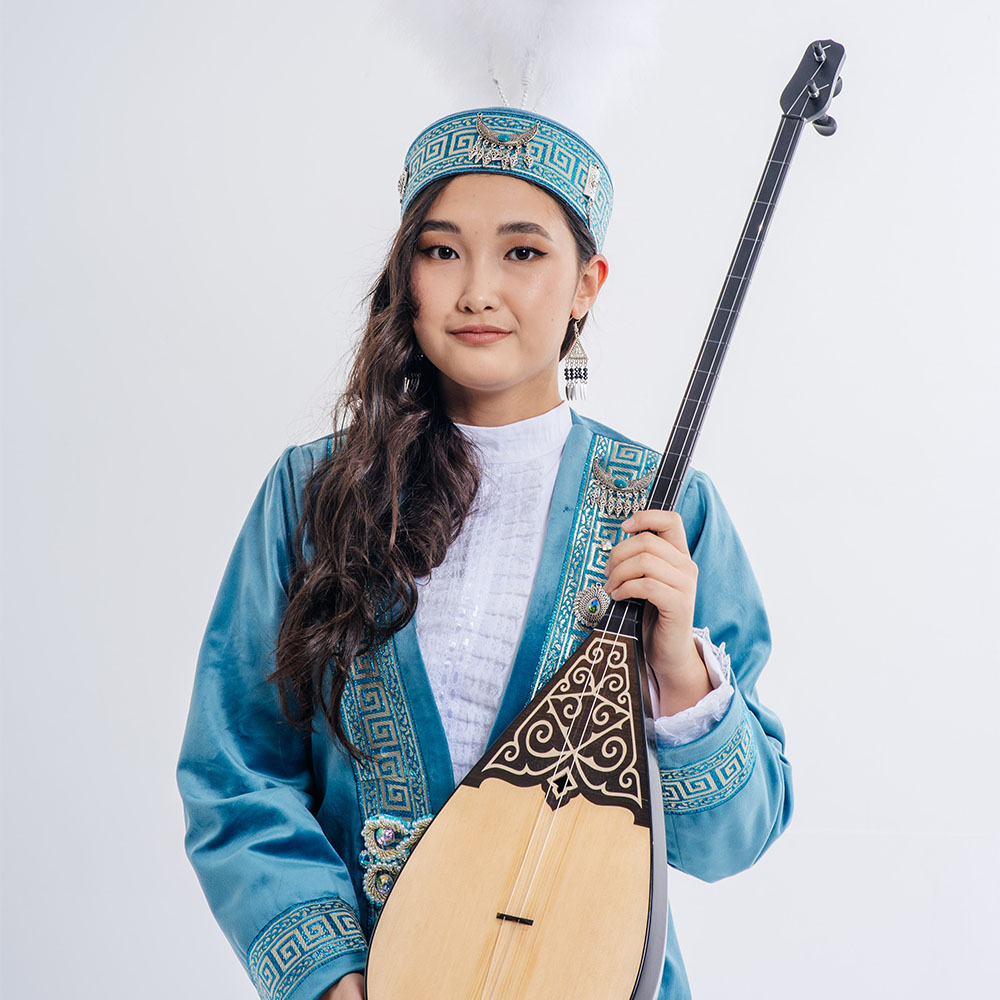
Rite of Wind and Shadow
Performance piece (2025–2026)

Within the framework of the Triennale, Nazira Omar, in a duo with Tañsulpan Buraqayeva — an artist and director from Bashqortostan — performs a musical piece by Mieko Shiomi. Like many of Shiomi’s works, the new piece is based on instructions — sometimes highly precise, sometimes allowing a great deal of freedom for musicians and performers to interpret. Drawing on interactions with the natural phenomena of wind and shadow, the piece is composed for traditional North and Central Asian instruments as well as the performers’ bodies, exploring the boundaries between sound and silence, light and dark, and questioning conventional ideas of what music is and the agency of those who compose and perform it.a

The Problem Child says:

“An elder once told me that it isn’t necessary to know a language; it’s enough to master a musical instrument. It’s a language that says much more about you than words ever could. I listen to the whisper of the wind and translate it with my lips, my hands, and my lungs. I hope you’ll hear it.”

Follow us on Instagram
Tselinny Center of Contemporary Culture