Rites
of Eternal Wind
Il Korkut Sonic Arts Triennale
Dedicated to sound and listening, the Triennale creates a space for a wide range of sonic practices without restricting them by institutional boundaries. Over the course of two months, Rites of Eternal Wind will host sound installations and live events, listening sessions and soundwalks, hybrid lectures, discussions and workshops, somatic performances and explorations of sonic rituals and environments where sound is absent or even impossible.
Tselinny Center of Contemporary Culture
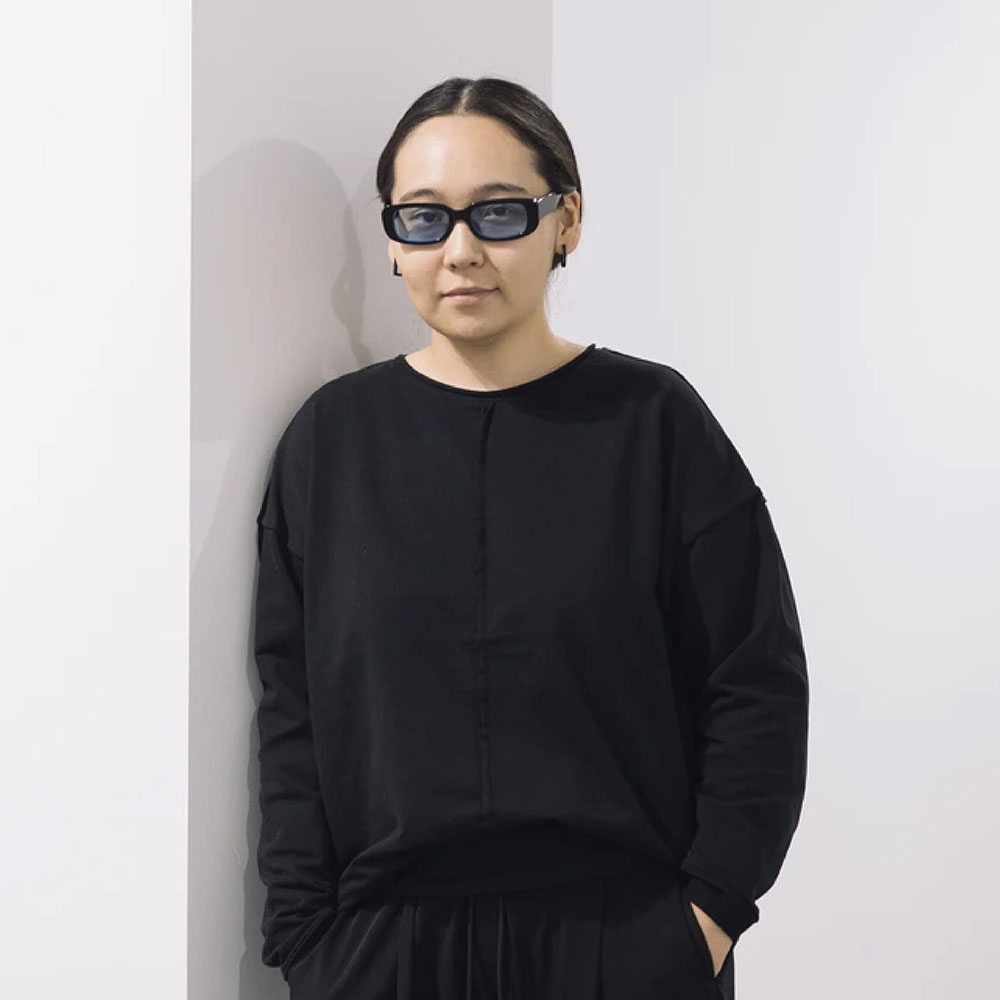
Lyazzat Khanim

Lyazzat Khanim (b.1994) is a visual artist from Kazakhstan who explores the medium of photorealistic painting, often combining it with video and digital art. Dissolving the borders between art and reality, quite literally, by making her paintings look as close to the objects they depict as possible, Lyazzat refocuses her attention on the weirdness of the mundane. Her paintings, usually depicting objects from our everyday life, and sometimes found in rather unusual places (who left the flat breads hanging on the wall?), exist in their own realm, almost like they’re left in a limbo they cannot escape. One can say though that Lyazzat places them in this limbo with good intentions, so the subliminal non-place between the worlds becomes a comfort zone where the consumer products can express their personality, contrary to the universality of mass production they’re destined for.

Currently, Lyazzat is working between Basel and Almaty, pursuing a Master degree in Fine Arts at the Institute Art Gender Nature, Basel Academy of Art and Design FHNW. In 2017 she graduated from Parsons School of Design.
Exhibition
RITES OF ETERNAL WIND EXHIBITION
The Rites of Eternal Wind brings together eleven works across diverse media and genres, united by an expanded understanding of sonic arts: practices of sounding and listening. While rooted in forms traditionally associated with sound exhibitions — such as multichannel installations by Almaty-based artist Rustem Myrzakhmetov and leading sound artist Cevdet Erek from Istanbul — the exhibition gradually extends into visual art and mixed media. These include Azadbek Bekchanov’s large-scale cotton print, which functions as a graphic musical score for his performance, and Ziliä Qansurá’s installation composed of “a thousand” stems of quray — an endemic plant and a key symbol of the Republic of Bashqortostan, from which a traditional flute is made. The curators do not shy away from difficult questions. Bengali artist Budhaditya Chattopadhyay’s participatory sound installation, for instance, invites viewers to “feed” clay pots so that they stop crying—an allusion to the Bengal Famine of 1943 and to similar tragedies in Central and North Asia that claimed millions of lives. Another work in similar direction is an installation by internationally renowned audio researcher and artist Lawrence Abu Hamdan, reflecting on life in the occupied Golan Heights, where wind energy infrastructure is gradually displacing the region’s Indigenous population. The exhibition also features several notable video installations that explore identity through listening and voice: a diptych by Kazakh–Turkish experimental vocalist Saadet Türköz; a film about quray players by Bashqortostan-based director Tañsulpan Buraqayeva; and an experimental work by Korean artist Sojung Jun exploring the history of the Koryo-saram diaspora in Almaty. A key artwork for understanding the Triennial’s central concept — listening and collective music-making as a shared practice — is Mieko Shiomi’s collective sonic sculpture, whose form recalls the jylanbas or asatayaq. The influential Japanese conceptual artist invited all Triennial participants to contribute: each was asked to bring or send “a bell or any other sounding object” and suspend it in a designated location. The work is accompanied (both playfully and respectfully) by a triptych of photorealistic paintings by Kazakhstani artist Lyazzat Khanym, who, drawing on one of Shiomi’s canonical works, offers her own interpretation of how sound and wind might be rendered visually. Most of the works presented in the exhibition were commissioned specifically for The Rites of Eternal Wind.
Follow us on Instagram
Tselinny Center of Contemporary Culture