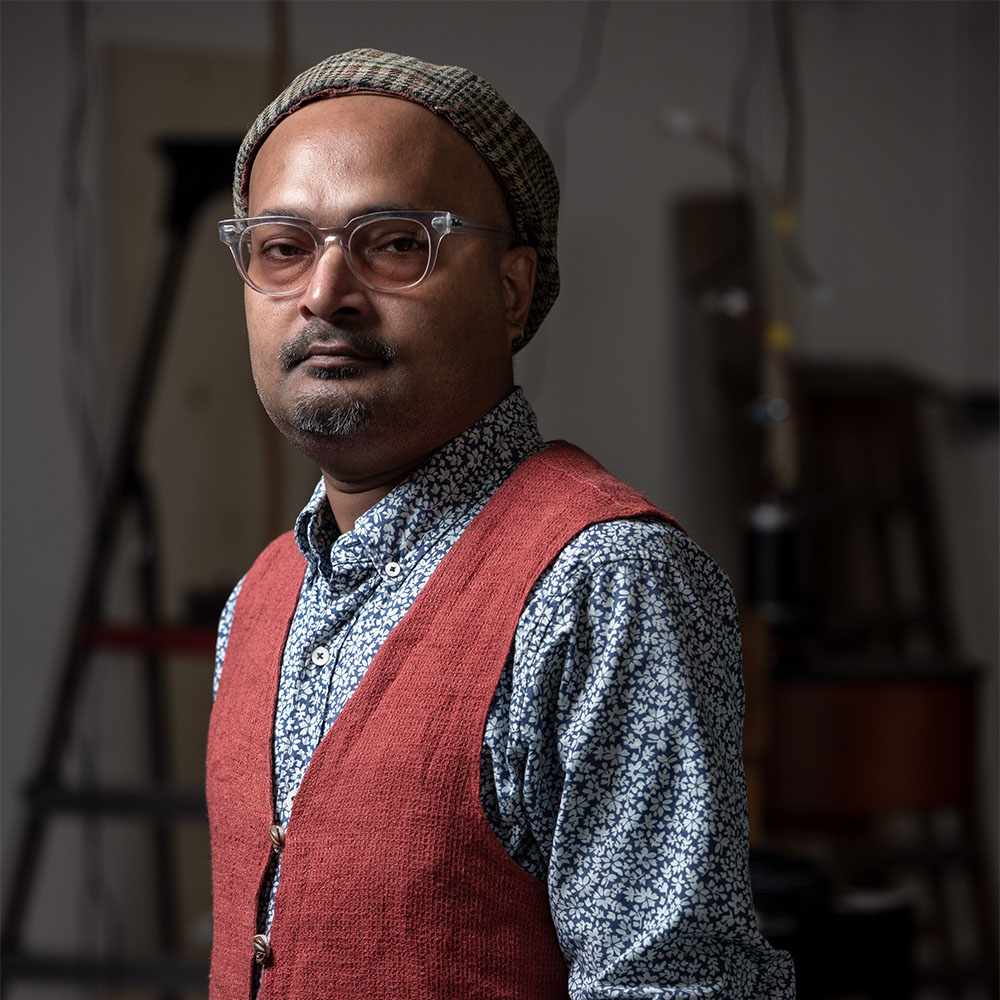
Budhaditya Chattopadhyay is a multidisciplinary artist, researcher, and writer, working and living between Bergen, The Hague, and Kolkata. He is well known for his critical academic research into how methods and technologies of audio capture, both historical and contemporary, influence the communities they turn their extractivist listening ear to. Analyzing colonial archives, artifacts of the mainstream recording industry, contemporary representations of artists from the Global Majority — and reframing the settler colonial epistemologies they’re rooted in — he is interested in the results of this research existing outside academia. Thus, many of Budhaditya’s works exist between the academic environment and contemporary art, addressing issues of decoloniality, migration, environment, and ecology through various sonorous media — from large-scale works for exhibition, sound installations and interfaces, to performances, often collective, and curatorial work focused on the communal potential of music-making and performing.
He is the author of five books, holds a PhD in Artistic Research and Sound Studies from the Academy of Creative and Performing Arts, Leiden University, and is currently a Marie Curie Postdoctoral Fellow at the Faculty of Fine Art, Music and Design, University of Bergen.
Land Without Food
Participatory sound installation (2026)
For Rites of Eternal Wind, Budhaditya Chattopadhyay commissioned an interactive installation titled Land Without Food, placing augmented, handmade Indigenous clay utensils often used for cooking rice in South Asia and Africa as sonic interfaces to convey a sound-driven, participatory, affective experience.
On the one hand, the work delves into the untold histories of the notorious 1943 Bengal famine in India, among other famines in different parts of the world, including Central and Northern Asia, past and present, through archival research. On the other hand, it invites the audience to engage in and activate intersubjective interactions that situate empathic feeding as a reparative act and a portal for recognizing contemporary hunger crises, shaped by settler colonial and neocolonial violence, such as those in Gaza and Sudan.