Bilawa Ade Respati is an Indonesian musician and performing artist based in Berlin. He performs on the Javanese Gamelan and the guitar, composing music for both instruments, incorporating elements of electronic music and algorithmic composition — solo, and in many collaborations.
Formally trained in Engineering Physics, Bilawa specializes in acoustic signal processing and music information retrieval, with a focus on the analysis of Javanese gamelan music. In his works, he takes a syncretic approach drawing from his various backgrounds: from engineering to performing art, from European music tradition (classical guitar) to the art of Javanese Karawitan. This leads to a broad artistic output, ranging from music for live performance, web sound installation, to music theater and the performing arts. His current artistic interest lies in the dialectic between tradition and innovation, as well as the revaluation of traditional values in contemporary life. This approach led Bilawa to engage with Resynthesising the Traditional, the project of Berlin’s CTM Festival where he contributed both as an artistic research lab fellow, and a co-host of the 2025’s lab edition in Almaty — a joint project by CTM, Tselinny, and Goethe-Institute Kazakhstan.
His current collaborations include the company Rubarb Dance and Art, under the direction of choreographer Ruben Reniers, as well as visual artist and lighting designer Emese Csornai and puppeteer Lisa Björkström. Last year, Bilawa released a collaboration with Mo’ong Pribadi via London’s Bloxham Tapes.
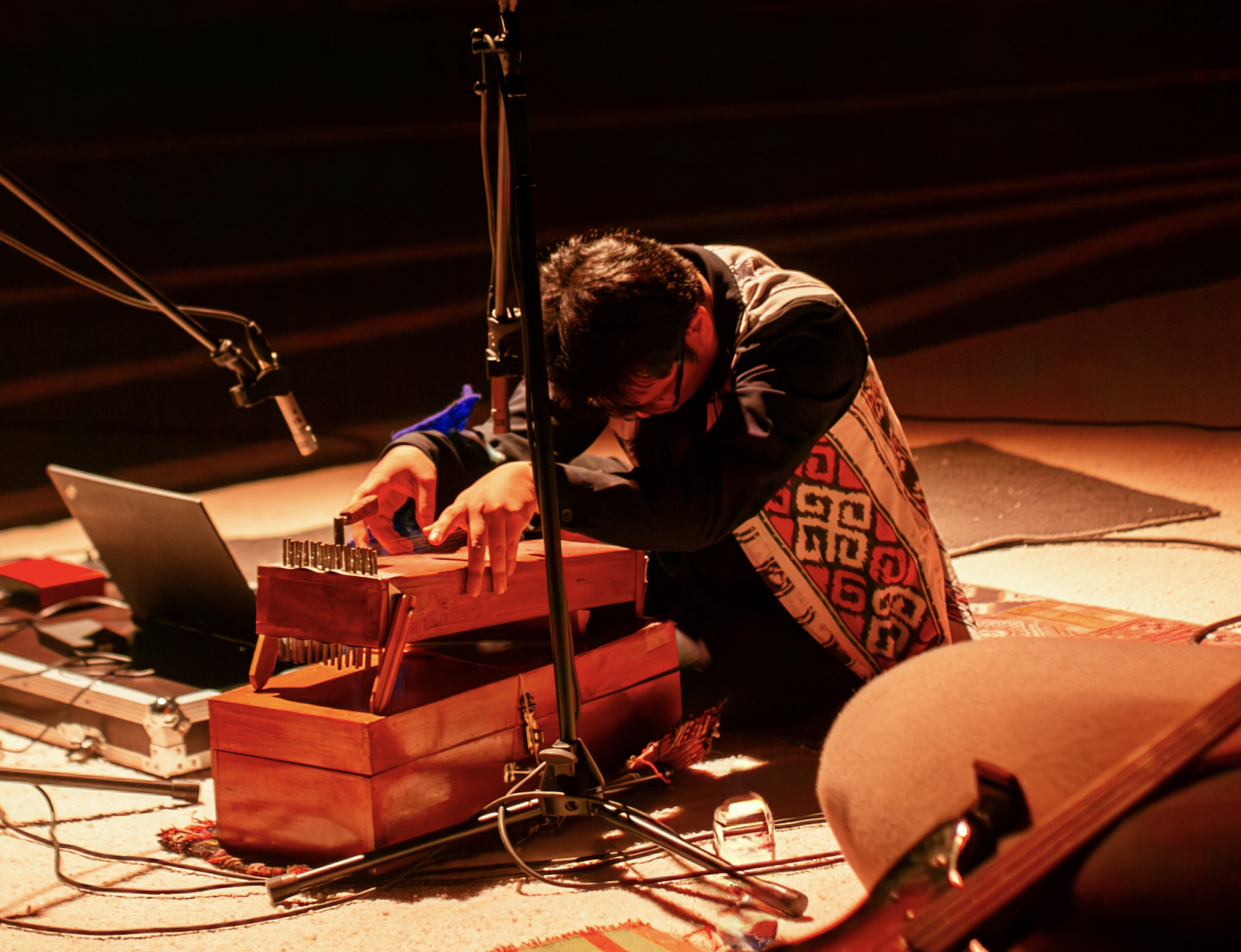
The Dream Has Still Not Whispered
Work-in-progress performance (2026)
For Rites of Eternal Wind, Bilawa was invited to commission a collective work with Şüräle and Karina Utomo — a collaboration with CTM Festival as part of their thematic strand Resynthesising the Traditional, which will be presented later this year in Berlin. Şüräle, a Bashqort sound artist based in Almaty, participated in the 2025 Resynthesising the Traditional edition in Kazakhstan, led by Bilawa. The two already know each other through this earlier collaboration, while Karina Utomo, an Indonesian extreme vocalist, has not yet met either of them — but she shares a common interest with Bilawa in Javanese sonic heritage, which has become a point of connection.
At the Triennale, Bilawa, Karina, and Şüräle will present their commission as a work in progress — a shared sonic space created to explore the concept of arwah/äruax, an ancestral spirit that appears, un/expectedly, in both Turkic and Indonesian cultures. Through a sound offering, the three engage within a scaffold of cyclical rhythms, haunting timbres, and the granularity of aural perception, creating soundscapes where ancestral mythologies are inseparable from the technological present, and where the boundaries of tradition are collectively tested and transformed. The work’s title refers to a Javanese tradition in which spiritual knowledge is often transmitted through whispering.
The commission is supported by Goethe-Institut Kazakhstan.
The Seeker says:
“From the shore of nonexistence to the shore of eternity, the wind travels faster than steel and ropes. They stretch, but cannot reach; they want not to scream, but to sing a song in the wind. Their mouths open soundlessly — for they were made without love, but with a hope for peace. They were left in peace. On the shore, someone left an inscription: “Forever with you” — without asking you.”